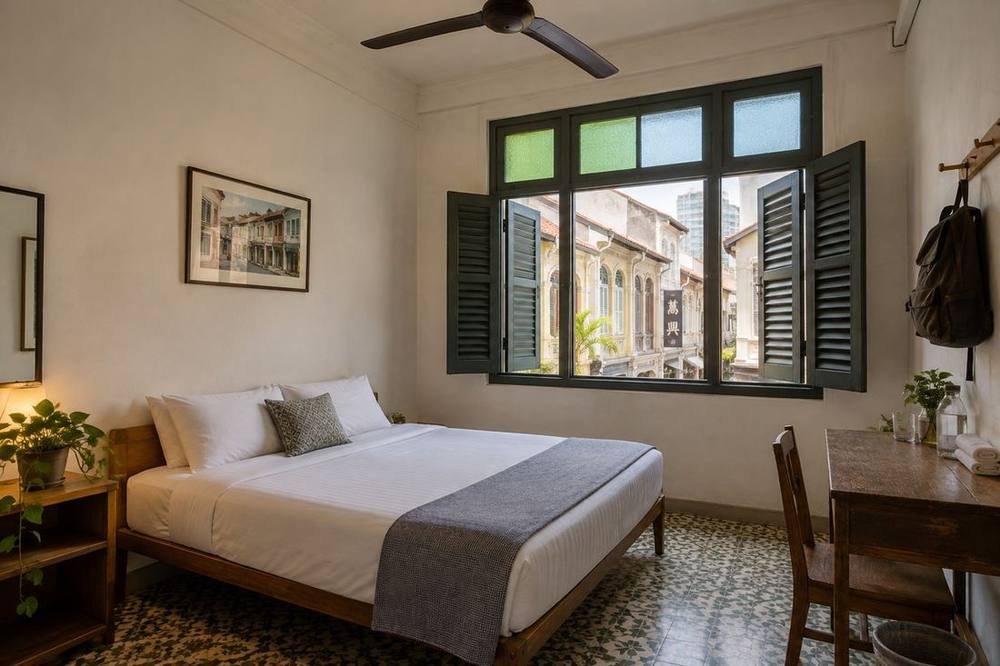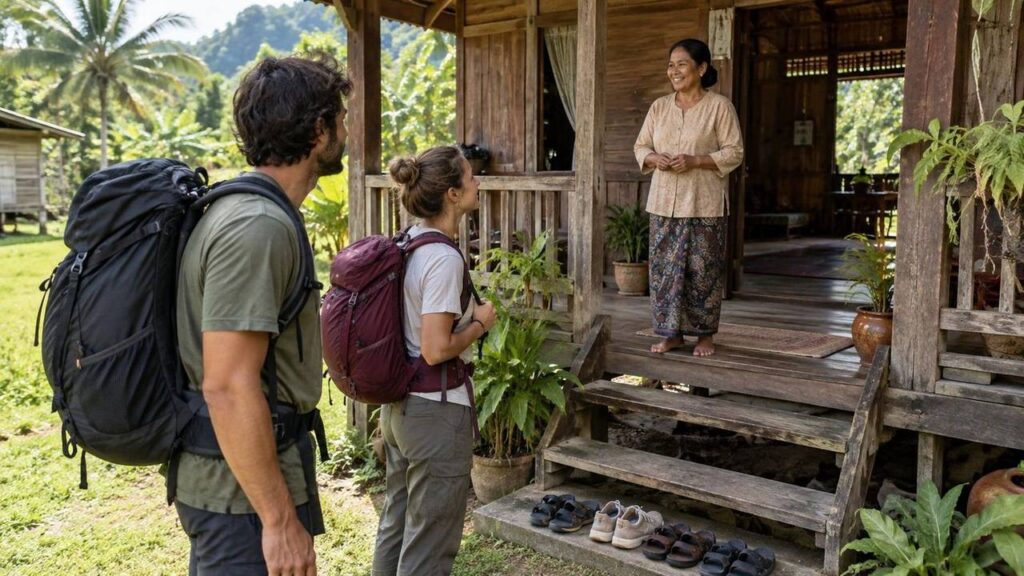

Picture two evenings. In the first, you are sitting on a hostel rooftop in George Town, swapping bus tips with a traveller from Chile. In the second, you are on the wooden floor of a kampung house, eating rice and gulai with a family who met you three hours ago. Both are great nights. They are just very different trips.
In Malaysia, you will see the word “homestay” everywhere, from village programmes to apartments on booking apps. That makes the choice between a hostel and a homestay more confusing than it should be. So let me break down what each one really means here, what you get, and when I would pick one over the other.
First, what “homestay” means in Malaysia
This is the part most travel blogs miss. In Malaysia, “homestay” can mean two quite different things.
1. The official homestay programme
The Malaysian Homestay Experience Programme (Program Pengalaman Homestay Malaysia, or PPHM) is run by the Ministry of Tourism, Arts and Culture (MOTAC). It was launched in 1995 in Temerloh, Pahang, under the Rural Tourism Master Plan. In this programme, you stay with a family in a village and join in their daily life.
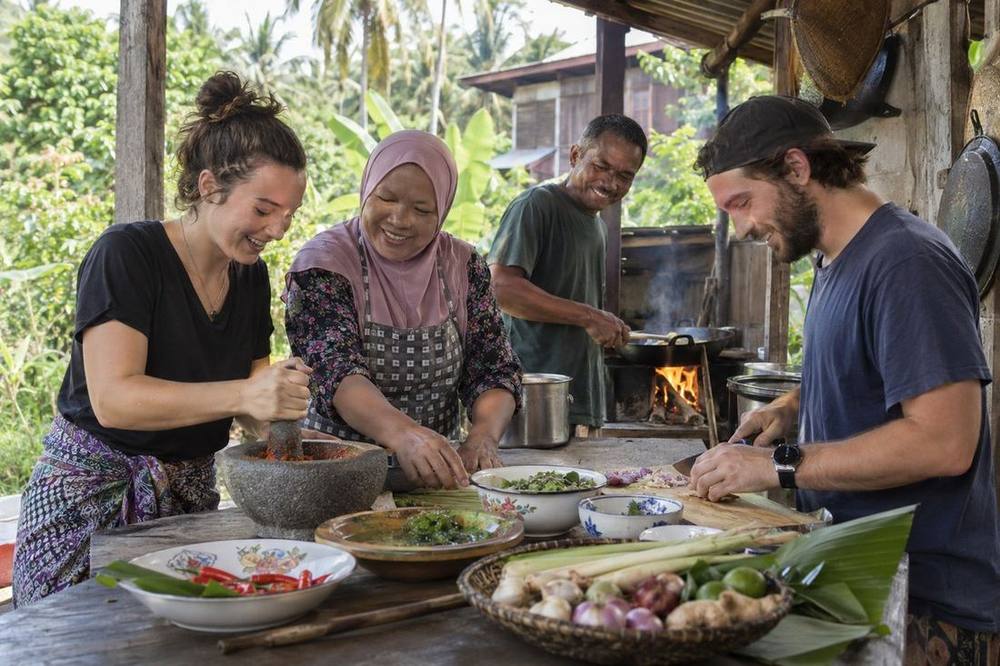
Tourism Malaysia describes activities like cooking food the traditional way, harvesting fruit, feeding livestock, playing kampung games such as kite flying, top spinning and congkak, and watching cultural dances or music. Some villages even put on a mock wedding. Villages in the programme are selected carefully and must follow the ministry’s guidelines.
It is bigger than most people think, with hundreds of villages taking part across the country. MOTAC’s own statistics show that most guests are Malaysians, so as a foreign backpacker, you will often be one of very few non-Malaysians there.
2. Private “homestays”
The second meaning is much more common in daily life. Many Malaysians call any private house, apartment or room for short-term rent a “homestay”. These are often whole houses for families going back to their hometown, or condo units in cities. The owner usually does not live there, and there are no village activities.
The rules for these private short-term rentals are still changing, and local councils often set their own. MOTAC’s own guidelines also say that houses in housing estates and Airbnb-style units cannot join the official homestay programme.
When I say “homestay” in this article, I mostly mean the official village kind, because that is the one that offers something a hostel cannot. I will mention private homestays where it matters.

What a hostel in Malaysia is like
Hostels in Malaysia are mostly found where backpackers go: Kuala Lumpur, George Town, Melaka, Ipoh, Cameron Highlands, Kota Kinabalu, Kuching and the islands. Many are in old shophouses that have been converted, with dorm beds upstairs and a common area downstairs.
A typical hostel gives you:
- A bed in a mixed or female-only dorm, often with a curtain and a reading light
- A locker (bring your own padlock)
- Shared bathrooms
- Free Wi-Fi and sometimes simple breakfast like toast and coffee
- A common room where you can meet people
- Staff who can help with buses, ferries and day trips
Some hostels also have private rooms. These can be a good middle option if you want quiet but still like the social side.
What makes a good hostel stand out is usually small things: staff who know the real bus times, a common room that is not just a corridor, and dorms that get cleaned every day. A good habit is to check reviews for staff names. When guests mention the person at the desk by name, it usually means the place is well run and friendly.
Hostels vs homestays: the main differences
| Hostel | Official village homestay | |
|---|---|---|
| Location | Towns, cities, islands, tourist areas | Rural villages, often away from public transport |
| Booking | Online, walk-in often possible | Usually through the homestay coordinator, often as a package |
| Who you meet | Other travellers | Local families and villagers |
| Food | Buy your own, sometimes breakfast | Home-cooked meals often included in packages |
| Privacy | Low in dorms, better in private rooms | Your own room, but you share a family home |
| Flexibility | High, easy to stay one night | Lower, often planned stays with set activities |
| Activities | Self-organised or tours via front desk | Village life, cooking, crafts, cultural shows |
| Best for | Solo travellers, short stops, meeting people | Culture, slow travel, small groups |
When a hostel makes more sense
A hostel is usually the better pick in these situations.
You are moving fast. If you are spending one or two nights in each place, a hostel near the bus station or train line is easy. You can check in late, leave early and not upset anyone.
You are travelling solo and want company. Hostels are the easiest place in Malaysia to find people to share a Grab ride, a boat to Perhentian or a hike in Cameron Highlands.
You are on a tight budget. A dorm bed is usually the cheapest bed in town.
You want flexibility. Hostels rarely need you to plan. Weather turns bad? Stay another night. Met a group heading to Taman Negara? Go with them tomorrow.
When a homestay makes more sense
You want to see real Malaysian life. This is the big one. In a village homestay, you will eat what the family eats, wake up to the call to prayer or roosters, and see how rubber, palm oil, paddy or fishing shapes people’s days.
You are travelling as a couple or small group. Homestay packages often work out better when shared. You also get a private room instead of a dorm.
You want to slow down. After weeks of buses and dorms, two nights in a kampung can feel like a real rest.
You are visiting rural Sabah or Sarawak. These two states have far more registered homestays than anywhere else. MOTAC’s figures show Sarawak and Sabah well ahead of any state in the peninsula. In Borneo, a homestay is often the only way to stay in some villages.
A common worry for first-time guests is that it will feel awkward to stay with strangers. In practice, many travellers find the ice breaks fast, usually in the kitchen. Offer to help peel shallots or stir the pot, and you will soon be laughing with the family, even with only a few shared words.
Things to know before booking a village homestay
Village homestays are wonderful, but they are not hotels. A few tips will help you and your host.
- Book ahead. Many programmes are set up for groups, so contact the coordinator before you arrive. MOTAC publishes a directory of homestay chairpersons and coordinators on its website.
- Ask what is included. Check if meals, activities and transport from the nearest town are part of the package.
- Plan transport. Most homestays are not on a bus route. You may need a taxi, Grab or a pickup arranged by the host.
- Dress modestly. Most kampungs are conservative. Cover shoulders and knees, especially around the mosque.
- Take off your shoes before you go into the house.
- Learn a few Malay words. “Terima kasih” (thank you) and “sedap” (delicious) go a long way.
- Be flexible. Plans can change because of weddings, funerals, rain or a family event.
Things to know before booking a hostel
- Read recent reviews about cleanliness, bedbugs and noise.
- Check dorm size. A 6-bed dorm is very different from a 20-bed one.
- Look for female-only dorms if that matters to you. Many places in Malaysia offer them.
- Ask about air-conditioning hours. Some hostels only switch it on at night.
- Budget for tourism tax. Most places add a small tourism tax for foreign guests, usually per room per night, on top of the price. Ask if it is included, and in a dorm, check how the hostel charges it. Registered village homestays and very small operators may not have to collect it, but booking apps often add it anyway.
I go into more detail on this in How to Spot a Good Budget Guesthouse.
What about private homestays and apartments?
Private homestays sit somewhere in the middle. You get space, a kitchen and privacy, which is great for groups or longer stays. But you lose the social side of a hostel and the cultural side of a village homestay.
They can be good value in towns where hostels are rare, like smaller east coast towns. Just read the house rules carefully. Some condos have strict rules about guests, check-in times and parking. On tax: if you book a private homestay through a booking app, expect the app to add tourism tax for foreign guests. If you book directly with a small owner, they may not have to charge it, so ask what the total price includes.
Can you mix both?
Yes, and I think this is the best way. A simple plan for two weeks might look like:
- Hostels in Kuala Lumpur and Melaka to start, while you get your bearings
- Two nights in a village homestay in Negeri Sembilan, Pahang or Johor
- Back to hostels for Cameron Highlands and George Town
- If you fly to Borneo, a longhouse or kampung homestay in Sarawak or Sabah
This gives you city energy, travel friends and at least one real home-cooked meal with a Malaysian family.
One tip for planning this: put the homestay in the middle of your trip, not right at the start. By then you will have adjusted to the heat, learnt a few Malay words and will be ready for a slower pace. Avoid placing it right before a flight, too, because rural transport can be slow and plans in a kampung often shift.
My quick answer
Choose a hostel if you are solo, short on time or short on money. Choose a village homestay if you want to understand Malaysia, not just see it. If you can, do both. Start by reading What to Expect at a Homestay: A Backpacker’s Guide to see if a village stay suits you, then book your hostels around it.
Sources
- Royal Malaysian Customs Department, General Guide on Tourism Tax: https://www.myttx.customs.gov.my/wp-content/uploads/2022/05/APPENDIX-A-General-Guide.pdf
- MOTAC, Laporan Statistik Program Pengalaman Homestay Malaysia (updated May 2026): https://www.motac.gov.my/wp-content/uploads/2026/06/Laporan-PPHM-Statistik-Mei-2026.pdf
- MOTAC, Malaysian Homestay Experience Program (PPHM) downloads: https://www.motac.gov.my/en/category/download/malaysian-homestay-experience-program/
- COMCEC / Ministry of Tourism Malaysia, Community Based Tourism presentation: https://www.comcec.org/wp-content/uploads/2021/07/4_Malaysia.pdf
- Tourism Malaysia, Homestay: https://www.tourism.gov.my/niche/homestay
- Malaysia Truly Asia, Homestay: Live Like a Local: https://www.malaysia.travel/explore/homestay-live-like-a-local
- MOTAC, Garis Panduan Program Pengalaman Homestay Malaysia: https://www.motac.gov.my/wp-content/uploads/2025/11/Garis-Panduan-Pendaftaran-Program-Pengalaman-Homestay-Malaysia-1.pdf (checked Oct 2026)
- MOTAC, Direktori Pengerusi & Penyelaras Homestay 2025: https://www.motac.gov.my/wp-content/uploads/2026/04/DIREKTORI-PENYELARAS-KLUSTER-HOMESTAY-2025.pdf (checked Oct 2026)
- Royal Malaysian Customs Department, Guide on Tourism Tax (Digital Platform Service Provider), 11 Mar 2025: https://www.myttx.customs.gov.my/wp-content/uploads/2025/03/Guide-on-DPSP-11032025.pdf (checked Oct 2026)
- iProperty, “Short Term Rental in Malaysia 2026: Legal Reality, Risks & What Hosts Need to Know” (Feb 2026): https://www.iproperty.com.my/guides/is-short-term-rental-airbnb-legal-malaysia-74128 (checked Oct 2026)