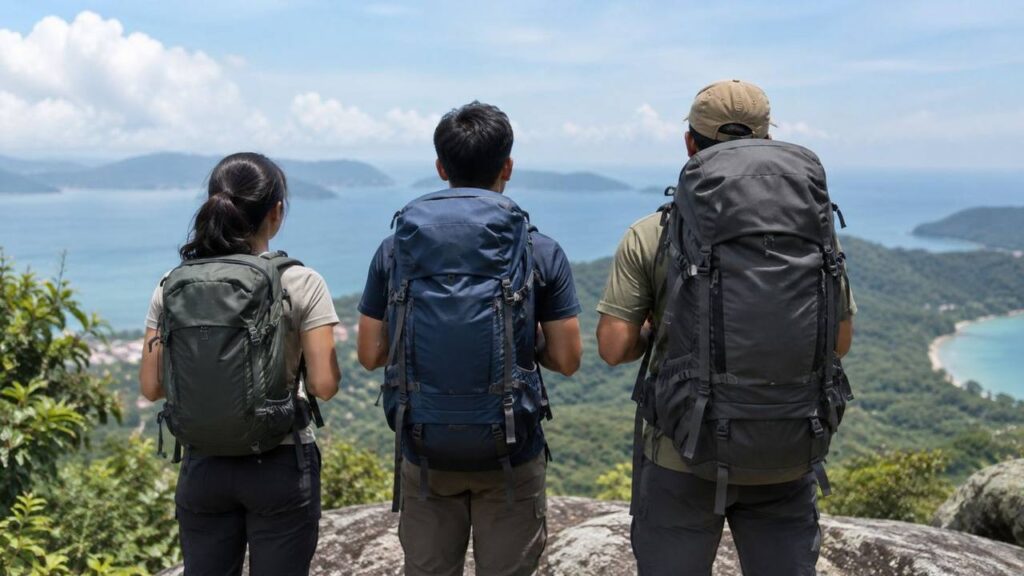

Picture this. You are standing at the Merang jetty, the boat is bobbing, and the boatman is waving you on. Your bag is heavy, the straps are cutting into your shoulders, and you still have to step over the side without dropping it in the sea. That is the moment you find out if you chose the right backpack.
A good backpack makes the whole trip feel lighter. A bad one turns every walk from the bus stop into a chore. Here is how I would choose one today, step by step.
Start with the trip, not the shop
Before you look at any bag, think about how you will travel. The best pack for a week of island hopping is not the same as the best pack for a month of city hostels.
Ask yourself a few simple questions:
- How long is the trip? A weekend, a week or a few months?
- How will you get around? Budget flights, long-distance buses, trains, ferries or your own car?
- Will you hike? Jungle trails in Taman Negara or a mountain climb need a different pack from city walking.
- Do you want to fly with carry-on only? This one decision limits your size more than anything else.
Pick the right size (capacity in litres)
Backpack size is measured in litres. Bigger is not always better, because a big bag tempts you to fill it.
REI, the US outdoor retailer, gives a rough guide for hiking packs: 30–50 litres for a weekend of 1–3 nights, 50–80 litres for 3–5 nights, and 70 litres or more for longer trips. For daypacks, it calls 21–35 litres the “sweet spot” for most hiking and travel use.
For backpacking Malaysia, where you stay in hostels and homestays and do not carry a tent, you can usually go smaller than those hiking numbers. Many travellers here are happy with something in the 35–45 litre range for trips of any length, because you can wash clothes as you go.
| Trip style | Rough size | Good for |
|---|---|---|
| Day trips, city walking | 15–25L | Water, rain jacket, snacks, camera |
| Weekend or carry-on travel | 30–40L | Hostels, budget flights, island trips |
| Long trip with some hiking | 40–55L | Mixed travel with extra gear |
| Camping, multi-day treks | 55L and up | Tent, sleeping bag, cooking kit |
I go into much more detail in 30L vs 40L vs 60L: Which Backpack Size Do You Need?.
Check the carry-on limits before you buy
AirAsia allows two pieces of cabin baggage with a combined weight of 7kg. The main bag must be no larger than 56cm x 36cm x 23cm, and the second smaller bag no larger than 40cm x 30cm x 10cm (AirAsia newsroom advisory; the same limits were listed on klia2.info, checked October 2026). Malaysia Airlines economy allows one cabin bag plus one personal item, with a total weight of 7kg, and its overhead bin size is listed as 56cm x 36cm x 23cm (checked October 2026, Malaysia Airlines).
So if you want to skip checked baggage, look for a pack that measures within 56 x 36 x 23cm when packed. Bring a measuring tape to the shop. A soft pack can bulge past the limit when it is full, so a bag with compression straps helps.
Fit matters more than brand
A RM800 pack that does not fit you will hurt more than a cheaper one that does. The most important number is your torso length, not your height.
REI explains how to measure it:
- Tilt your head forward and find the bony bump at the base of your neck. This is your C7 vertebra.
- Put your hands on your hips, with your thumbs pointing to your back. Find the top of your hip bones (the iliac crest).
- Ask a friend to measure from the neck bump down to the imaginary line between your thumbs.
Many packs come in sizes based on this length, and some have an adjustable back so you can fine-tune it.
When you try a pack on in a shop, ask to fill it with some weight. An empty bag always feels comfortable. Walk around the shop for 10 minutes and climb some stairs if you can.
Buying online? Check the return policy first, then load the bag at home with your real kit and wear it around the house for an hour. If it rubs or pulls, send it back before you cut off the tags.

The hip belt does the heavy lifting
This is the part most first-time buyers skip. REI says that 80 percent or more of a backpack’s weight should be supported by your hips, not your shoulders. Your legs and hips are much stronger than your shoulders, so let them do the work.
Look for these things:
- A padded hip belt that wraps over the top of your hip bones.
- Enough adjustment so the buckle closes with some room to spare.
- Small pockets on the belt for your phone, Touch ‘n Go card or snacks.
For a small daypack under 20 litres, a thin strap or no belt is fine. For anything you will carry with all your clothes inside, a proper hip belt is a must.
Padded shoulder straps and a chest strap
The shoulder straps should be padded, wide enough not to dig in, and shaped to your body. Women-specific packs often have narrower, more curved straps and shorter torso sizes, which many women find more comfortable.
A chest strap (also called a sternum strap) clips across your chest. It stops the shoulder straps sliding outwards and keeps the bag steady when you walk fast to catch a bus.
On bigger packs, look for load lifters. These are small straps at the top of the shoulder straps that pull the bag closer to your back. I explain how to set all of these in How to Wear a Backpack the Right Way (and the Mistakes to Stop Making).
Frame or no frame?
Most travel and hiking packs today have an internal frame. This is a light sheet or rods hidden in the back panel. It helps the bag keep its shape and moves the weight to your hips.
Frameless packs are lighter but less comfortable when heavy, so they suit small loads. External frame packs are not needed for travel in Malaysia. My rule: if you carry more than a day’s worth of stuff, get a frame.
Think about the back panel in our heat
Malaysia is hot and humid all year. A bag pressed flat against your back will soak your shirt in minutes, even on a short walk from the LRT.
Look for a back panel with mesh, foam channels or a “suspended mesh” gap that lets air move. It is not magic, but it helps.
Water resistance and rain protection
If you travel during the Northeast Monsoon, you will get wet. MetMalaysia says this monsoon runs from November to March and brings heavy rain, especially to the east coast states of Peninsular Malaysia, west Sarawak and east Sabah. Even outside monsoon season, afternoon storms are common.
What to look for:
- Water-resistant fabric that dries quickly.
- A rain cover, either built in or bought separately. This is the easiest fix.
- A roll-top or covered zips if you want more protection.
Even with a cover, pack anything important (passport, phone, power bank) in a zip bag or dry bag inside. No backpack is fully waterproof at the seams and zips.
How it opens: top-loading vs clamshell
Top-loading bags open from the top, like a sack. They are common on hiking packs and are simple and strong. The downside is that your shirt at the bottom means unpacking everything.
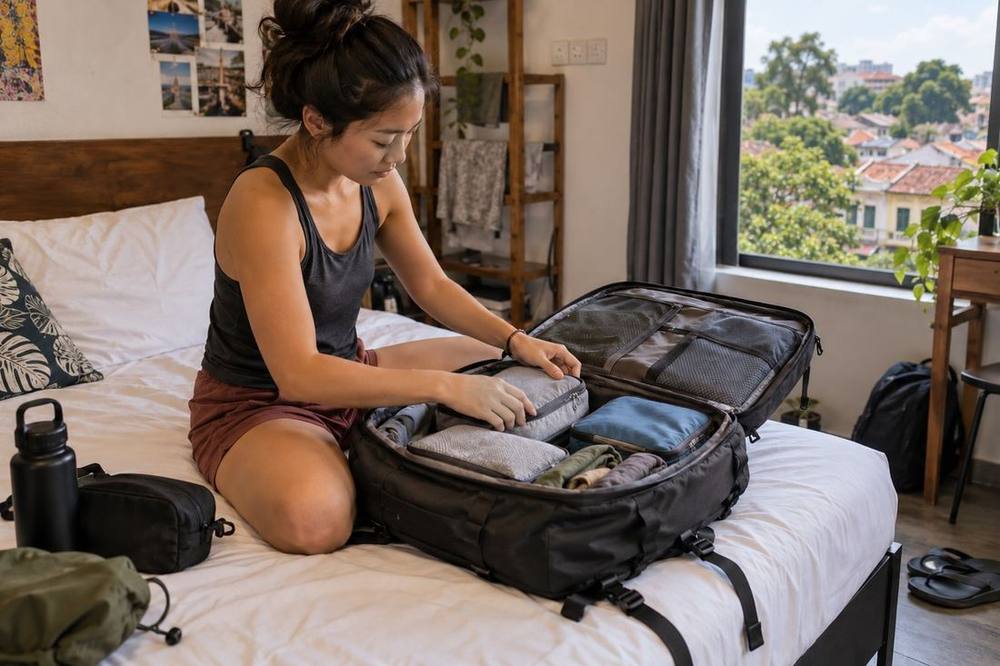
Clamshell or panel-loading bags open all the way round, like a suitcase. In REI’s travel pack reviews, one clamshell bag is praised for giving easy access to “every nook and cranny”. For hostels and homestays, where you pack and unpack every couple of days, this style is much easier.
Compartments and pockets
You do not need 20 pockets, but a few well-placed ones help:
- A laptop or tablet sleeve near your back, if you carry one.
- A small top or front pocket for your passport, cards and earphones.
- Side pockets big enough for a 1-litre water bottle. You will drink a lot here.
- Hidden pockets against the back panel for money and cards.
Lockable zips and security
Bag security matters in crowded places like night markets and bus terminals. Look for zips with two pulls that can be clipped or locked together. Some travel packs have zips that tuck into a hidden channel, which makes them harder to open while you walk. A small combination lock is cheap and handy for hostel lockers too.
You may see “TSA locks” advertised. These are designed for US airport security, so you only really need one if you are flying to or through the United States.
Weight of the empty bag
With a 7kg cabin limit, a heavy empty bag eats into your allowance before you pack a single shirt. Check the weight on the label.
A quick checklist before paying
- Does it fit your torso length?
- Is most of the weight on your hips when loaded?
- Will it fit the airline cabin limit you need?
- Does the back panel let some air through?
- Does it have a rain cover, or can you buy one?
- Can you open it easily in a small hostel bunk?
- Can you lock or secure the zips?
Common first-time mistakes to avoid:
- Buying by brand or colour before checking torso fit.
- Trying it on empty and never feeling it with weight inside.
- Going too big “just in case”, then filling every litre.
- Ignoring the empty weight, which matters with a 7kg cabin limit.
If you are still unsure what style suits your plans, read Types of Backpacks: Which One Suits Your Kind of Trip?. Then go to a shop, put some weight in the bag, and walk around for 10 minutes before you pay. Your shoulders will thank you at the next ferry jetty.
Sources
- REI, “How to Choose a Backpack: Sizing & Fit Guide”: https://www.rei.com/learn/expert-advice/backpack.html
- REI, “Backpacks: Fit & Torso Size Guide”: https://www.rei.com/learn/expert-advice/backpacks-adjusting-fit.html
- REI, “Daypacks: How to Choose”: https://www.rei.com/learn/expert-advice/daypack.html
- REI, “The 7 Best Travel Backpacks of 2026”: https://www.rei.com/learn/expert-advice/best-travel-backpacks.html
- AirAsia Newsroom, “AirAsia Travel Advisory: Cabin Baggage Allowance Update”: https://newsroom.airasia.com/news/2020/7/6/airasia-travel-advisory-cabin-baggage-allowance-update
- klia2.info, “Baggage Information for AirAsia Flights”: https://www.klia2.info/airlines/airasia-baggage-info/
- Malaysia Airlines, “Carry-On & Cabin Baggage Rules”: https://www.malaysiaairlines.com/hq/en/travel-info/baggage/cabin-baggage.html
- MetMalaysia, “Weather Phenomena”: https://www.met.gov.my/en/pendidikan/fenomena-cuaca/