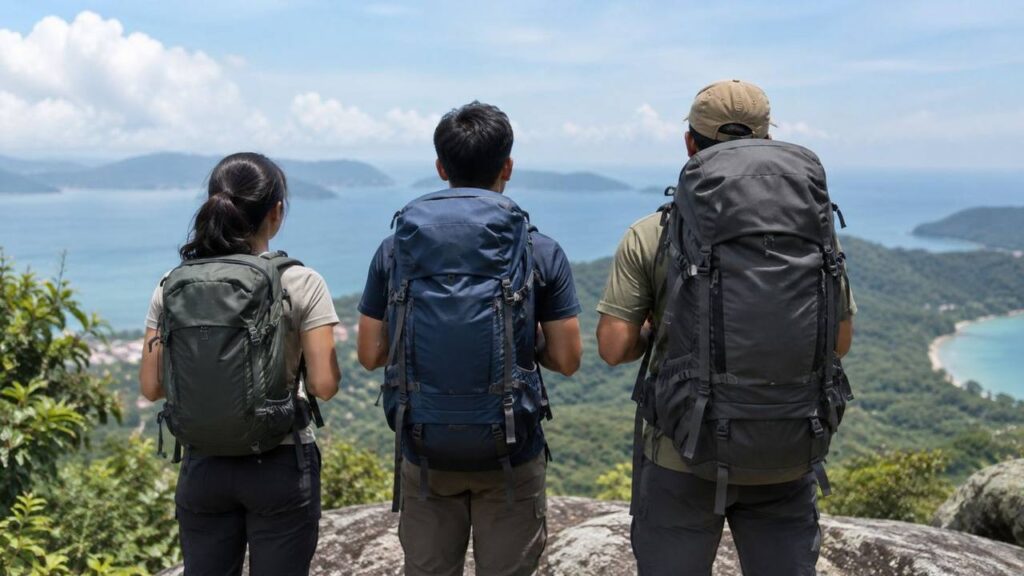
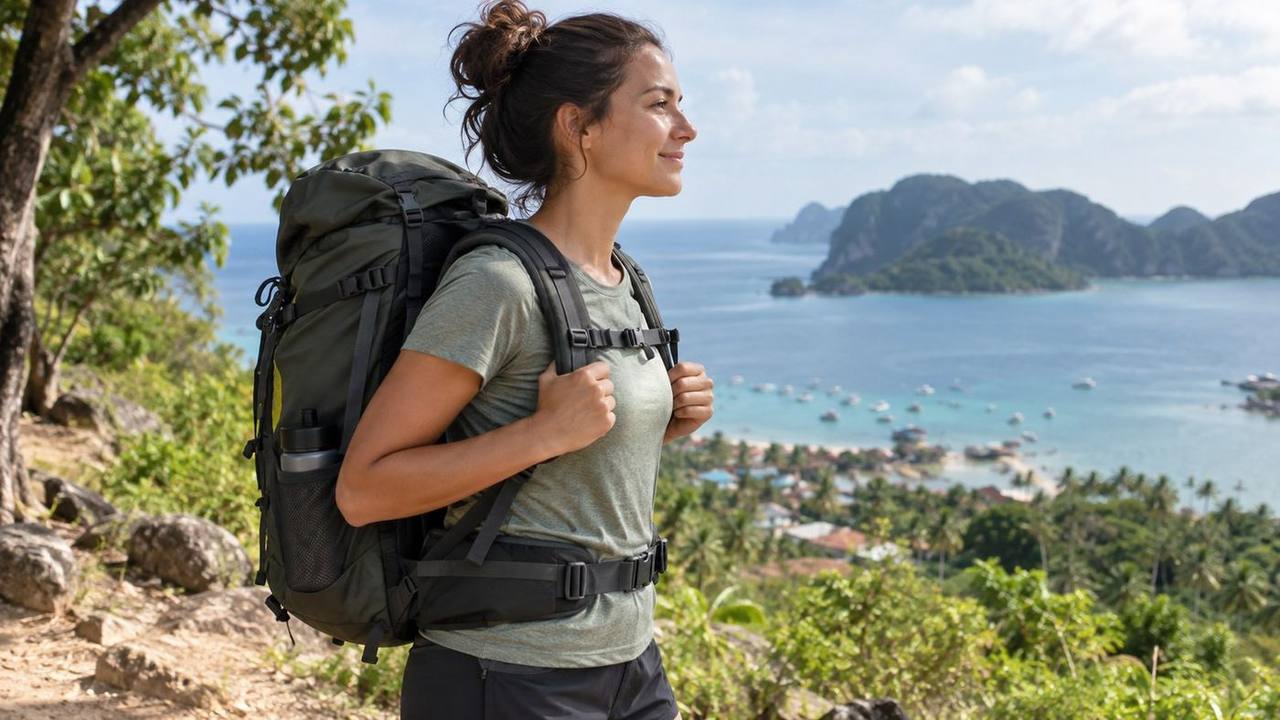
You can spot a sore backpacker from across the bus terminal. The bag hangs off one shoulder, it swings with every step, and the bottom bumps against the back of their legs. By the end of a day walking around Georgetown or Melaka in the heat, that person is rubbing their neck and looking for a place to sit.
The good news is that most backpack pain comes from how the bag is worn and packed, not from the bag itself. A few small changes can make a big difference. Here is how to wear a backpack properly.
Why the way you wear it matters
When a bag sits low or hangs on one side, your body leans to balance it. You might not notice at first. After a few hours, though, that lean pulls on your neck, shoulders and lower back.
OrthoInfo, the patient website of the American Academy of Orthopaedic Surgeons, lists the warning signs to watch for (its advice is written for school bags, but it applies to travellers too): pain in your back, neck or shoulders while or after carrying a bag, and struggling to put it on or take it off. It says these can mean the bag fits badly or is too heavy.
If you notice any of these, stop and adjust before you carry on.
The right way: both straps, every time
This is the simplest rule and the one most people break. OrthoInfo’s advice is to always use both shoulder straps. Two straps share the weight across both sides of your body so you can stand up straight.
Yes, it takes a few extra seconds. It is still faster than dealing with a stiff neck on a long overnight bus ride to Kota Bharu.
Adjust in the right order
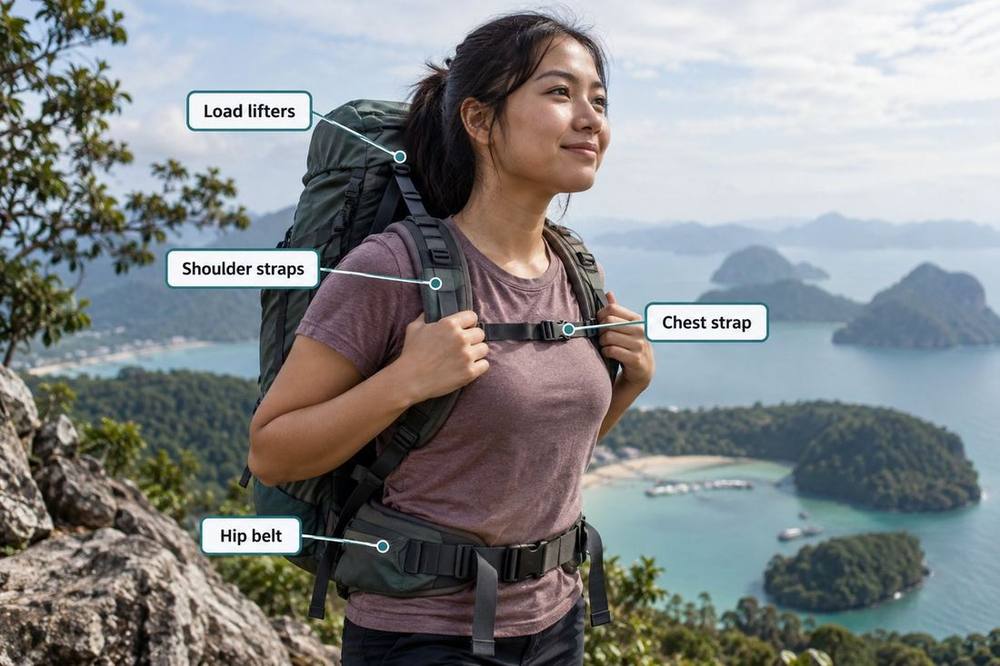
Most backpacks have four sets of straps. The order you tighten them matters. REI, the US outdoor retailer, recommends this sequence:
- Hip belt
- Shoulder straps
- Load lifters (on bigger packs)
- Chest strap (sternum strap)
Loosen everything first, put the bag on, then work through the list.
1. Hip belt first
The hip belt carries most of the load on a bigger pack. REI says 80 percent or more of the weight should rest on your hips. Your hip and leg muscles are far stronger than your shoulders.
Position the padded part so it hugs the top of your hip bones. REI says it should reach a little past the front of your hip bones, with at least an inch of space on each side of the buckle. Then tighten it firmly.
If the belt sits on your waist or tummy instead of your hip bones, the pack is probably the wrong torso size for you.
2. Shoulder straps next
Now pull the shoulder straps down and back. They should wrap snugly over your shoulders with no big gaps, but they should not be carrying most of the weight. OrthoInfo also says to tighten the straps so the load stays close to your back.
A bag that sits close and high is easier to control than one hanging away from your body.
3. Load lifters
These are the small straps that run from the top of your shoulder straps to the top of the pack. REI suggests they should angle back at roughly 45 degrees. Pull them gently to bring the top of the bag towards you.
Do not overtighten them. Too much tension can pinch your shoulders.
4. Chest strap last
Clip the chest strap and slide it up or down so it sits roughly an inch below your collarbones, as REI suggests. It keeps the shoulder straps from sliding out and stops the bag swaying. It should feel snug, not like it is squeezing your chest.
Re-adjust through the day
Your straps are not “set and forget”. Change them when:
- You put on or take off a rain jacket or thicker layer.
- You add a big bottle of water or a bag of food from the kedai runcit.
- You switch from walking on flat pavement to climbing a jungle trail.
- The bag starts to feel heavier on one side.
A quick tug on the hip belt and shoulder straps takes five seconds and saves a lot of aches.
Pack it so it carries well
How you load the bag matters as much as how you wear it.
REI’s packing advice for hiking packs splits the bag into zones. Bulky gear you do not need until later goes at the bottom. Denser, heavier items go in the middle “core” zone, close to your back. Bulkier things you might need during the day go at the top.
OrthoInfo gives similar advice for everyday backpacks: put heavier items low and towards the centre.
In practice, for a travel pack in Malaysia, that looks like this:
- Bottom: sleeping clothes, sarong, spare flip-flops.
- Middle, against your back: laptop, water, toiletries bag, anything heavy.
- Top: rain jacket, a light layer for cold buses, snacks.
- Small pockets: passport, phone, cards, tissue for the toilet.
Fill empty spaces so things do not slide around. A bag with a loose load will shift every time you step onto a ferry or jump off a bus.
A simple trick for a steady load: tighten the side compression straps after packing, then shake the bag gently. If you hear or feel anything move, stuff a T-shirt or packing cube into the gap.
The wrong ways to wear a backpack
Now for the common mistakes. Most travellers make at least one of them.
Slinging it over one shoulder
It looks casual, but it pulls your body to one side. You end up leaning, walking off balance and straining your neck, upper back and even your hips and core. Use both straps, even for short walks.
Letting it hang too low
When the bag drops below your hips, the weight drags your shoulders down and back. It also bounces with each step. Pull the shoulder straps tighter so the bag rides higher, and use the hip belt.
Leaving the straps loose
Loose straps let the bag swing from side to side. That swinging rubs your shoulders and back and can cause chafing, especially when you are sweaty in our humid weather. A steady load is easier to carry.
Ignoring the hip belt
Lots of people tuck the hip belt behind the bag because it feels like extra effort. On a large pack, this puts nearly all the weight on your shoulders. Clip it in.
Carrying too much
No amount of strap adjusting will fix a bag that is simply too heavy. For school children, the American Occupational Therapy Association suggests a backpack should weigh no more than 10 percent of the child’s body weight. That figure is for kids, not adult travellers, but the idea is the same: lighter is kinder to your back.
If your pack is too heavy to lift easily, take a few things out. You can buy most toiletries, sunscreen and even clothes cheaply in Malaysia.
| Do this | Not this |
|---|---|
| Use both shoulder straps | Sling it over one shoulder |
| Hip belt on top of your hip bones | Hip belt on your waist or tucked away |
| Bag high and close to your back | Bag hanging low and swinging |
| Heavy items in the middle, close to you | Heavy items at the very top or outside |
| Re-adjust when you change clothes | Set the straps once and forget them |
Lifting your bag safely
Many injuries happen when you swing a heavy bag up, not while you are walking. OrthoInfo’s advice for luggage is to bend at the knees, lift with your legs, hold the bag close and avoid twisting.
A simple routine: lift the pack onto a bench or your bent knee, slip one arm through, then the other, then clip the hip belt. When you put it into an overhead rack on a bus or train, lift it onto the seat first if you can.
Wearing a daypack in crowds
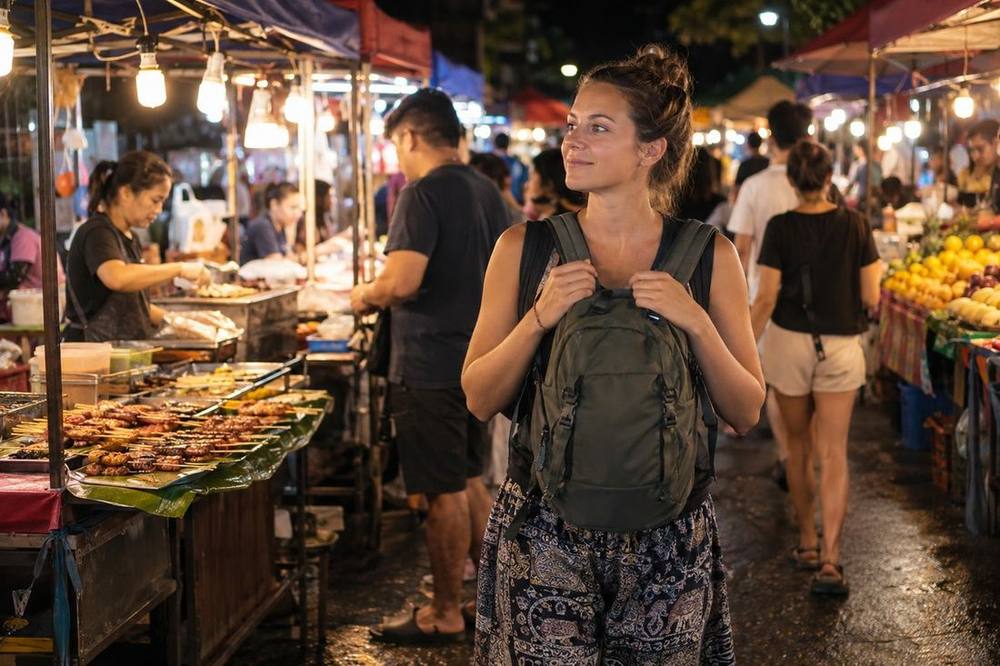
In crowded places, like a pasar malam or the LRT at rush hour, many travellers turn their daypack round and wear it on the front. It keeps the bag out of other people’s faces and keeps your zips where you can see them. Just switch it back for longer walks, so the weight sits properly on your back.
If your bag still hurts after all this, it may simply be the wrong size or shape for your body. Read How to Choose a Backpack for Travel: A Practical Guide to check the fit, and 30L vs 40L vs 60L: Which Backpack Size Do You Need? to see if a smaller bag would suit you better.
For your next trip, try this: before you leave your room, put the pack on, go through the four straps in order, and walk once around the room. If it does not sway, you are ready.
Sources
- OrthoInfo (American Academy of Orthopaedic Surgeons), “Backpack Safety”: https://www.orthoinfo.org/staying-healthy/backpack-safety
- OrthoInfo (American Academy of Orthopaedic Surgeons), “Tips for Lifting and Carrying Luggage”: https://www.orthoinfo.org/staying-healthy/tips-for-lifting-and-carrying-luggage/
- REI, “Backpacks: Fit & Torso Size Guide”: https://www.rei.com/learn/expert-advice/backpacks-adjusting-fit.html
- REI, “How to Choose a Backpack: Sizing & Fit Guide”: https://www.rei.com/learn/expert-advice/backpack.html
- REI, “How to Pack a Backpack”: https://www.rei.com/learn/expert-advice/loading-backpack.html
- AOTA CommunOT, “6 Ways to Promote Safe Backpack Use”: https://communot.aota.org/blogs/katie-riley/2019/09/06/6-ways-to-promote-safe-backpack-use