It is easy to pack a tangle of cables, two chargers for every device, a hair dryer and a tiny speaker you use exactly once. Half of it comes home without ever leaving the bag. A smaller tech pouch means a lighter backpack.
Gadgets can make travel easier, but each one adds weight, needs charging and is one more thing to lose. Here is what I think earns a place in your bag for Malaysia, and what you can leave at home.
A quick test helps. For each gadget, ask: “Will I use this at least every few days?” and “Can my phone already do this?” If the answers are no and yes, leave it out.
First: power in Malaysia
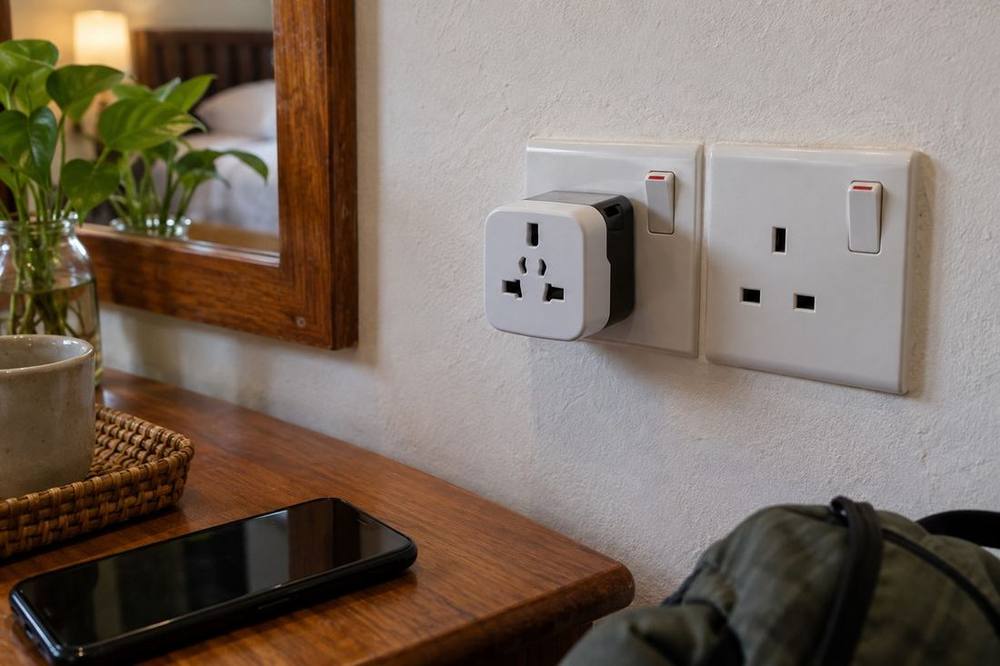
Before buying anything, check what your devices need. Malaysia uses Type G plugs (three rectangular pins, the same shape used in the UK). Tenaga Nasional (TNB), the national power company, lists the supply as 230V, 50Hz. Many travel guides, including AirAsia’s, still say 240V, but the advice below is the same either way.
That means:
- If you are from the UK, Singapore or Hong Kong, your plugs should fit.
- If you come from Europe, the US, Australia, Thailand or elsewhere, you will need an adapter.
- Most phone, laptop and camera chargers are “dual voltage” (they say something like 100–240V on the label). These work fine with just an adapter.
- Single-voltage devices made for 110–120V countries, such as some hair dryers or straighteners, need a converter, not just an adapter. Plugging one straight into a Malaysian socket can damage it.
Gadgets worth bringing
1. A universal travel adapter with USB ports
This is the one gadget nearly everyone needs. Pick a compact one with built-in USB-A and USB-C ports. You can then charge your phone, power bank and earbuds from one wall socket. Many budget rooms and dorms only have one or two sockets, so this matters.
2. A power bank
Long bus rides, ferry days and full days of using maps will drain your phone. A 10,000mAh power bank covers most people. A 20,000mAh one is heavier but can charge a phone several times.
Check airline rules, though. Power bank rules have tightened in the last few years, and they vary by airline. As a general guide:
- Power banks go in your carry-on only, never in checked baggage.
- Many airlines limit how many you can carry and how powerful each one can be, measured in watt-hours (Wh). The rating is printed on the power bank, so check yours.
- Many airlines now ban using or charging a power bank during the flight.
- Some ask you to keep it with you, under the seat or in the seat pocket, rather than in the overhead bin.
Older blog posts may quote rules that are already out of date, so check your airline’s own website before you fly. Charge your phone before boarding and keep the power bank where you can reach it.
3. One fast charger and good cables
Instead of a charger for each device, bring one small multi-port USB-C charger. Then pack one or two quality cables, ideally USB-C to USB-C, plus whatever your phone needs. A short cable is less likely to tangle.
4. Your phone (it does most jobs)
Your phone is your map, camera, ticket wallet, translator and torch. Before you go, download:
- Offline maps of the areas you will visit
- Grab, which is widely used for rides and food delivery in Malaysia
- Your bank and airline apps
Think about a local SIM card or an eSIM for data. Before you choose, check that your phone accepts other networks’ SIM cards and, for an eSIM, that it supports one. Compare a few networks’ coverage maps if you plan to visit rural areas or Borneo, because signal can drop off in the interior and on small islands. Save your hostel address and key bookings offline in case you lose data for a day.
5. Earphones or earbuds
Overnight buses, noisy dorms and long ferry rides are much nicer with earbuds. Noise-cancelling ones are a luxury, but worth it if you use a lot of night transport.
6. A small headlamp
Hostel dorms after lights-out, power cuts, night walks in national parks, and early starts for sunrise hikes all call for a headlamp. It frees your hands and saves your phone battery. In jungle parks it is essential. Mulu National Park lists a torchlight in its own packing list.
7. An e-reader (for readers)
If you read a lot, an e-reader is lighter than even one paperback. The battery lasts for weeks, which is perfect for long bus journeys.
Gadgets to leave behind
Hair dryer and straighteners
Many hotels and some guesthouses provide hair dryers, and Malaysian humidity undoes straightened hair in minutes anyway. If your device is single-voltage, it is even more reason to leave it home.
A laptop (unless you work)
Laptops are heavy, need careful protection from rain and humidity, and make you a theft target. If you are not working on the road, a phone or small tablet is enough for booking and emails.
Several cameras
Modern phones take excellent photos. If you love photography, bring one camera and one versatile lens. Leave the extra lenses, tripods and gimbals unless photos are the main reason for your trip.
A portable speaker
Most hostels, beaches and jungle lodges are not places where people want your music. Earbuds are kinder and lighter.
Travel kettle or immersion heater
Most budget rooms in Malaysia have hot water dispensers in the common area, and a kopi from the nearest mamak costs very little. A kettle is rarely worth the space. If you need hot water at odd hours, ask at reception before you buy anything.
Duplicate chargers
One multi-port charger replaces three or four separate bricks. Leave the rest.
Quick comparison
| Gadget | Bring or leave? | Why |
|---|---|---|
| Universal adapter with USB | Bring | Malaysia uses Type G sockets |
| Power bank | Bring | Long travel days, carry-on only |
| Multi-port charger | Bring | Replaces several chargers |
| Headlamp | Bring | Dorms, power cuts, jungle |
| Earbuds | Bring | Night buses and noisy dorms |
| E-reader | Optional | Light, long battery life |
| Laptop | Only if working | Heavy, theft and humidity risk |
| Hair dryer or straightener | Leave | Humidity, voltage issues |
| Speaker | Leave | Rarely used, annoys others |
| Extra camera gear | Leave | Phone is usually enough |
Looking after electronics in the heat and humidity
Malaysia’s climate is hard on gadgets. A few simple habits help:
- Keep electronics in a dry bag or zip-lock bag, especially on boats and in the rainy season.
- Toss a few silica gel packets in your tech pouch to absorb moisture.
- Do not leave devices in direct sun or in a hot car.
- If your phone gets wet, switch it off and let it dry fully before charging.
- Let a cold device from an air-conditioned bus warm up a little before using it outside, as condensation can form.
A common mistake is plugging in a damp phone or cable “just to check” it still works. Moisture plus power is what does the real damage. Give it time, and carry a spare cable so one wet lead does not leave you stuck.
A lean tech pouch
For a typical backpacking trip in Malaysia, this is all you need:
- Phone with offline maps and Grab
- 10,000mAh power bank
- Universal adapter with USB ports
- One small multi-port charger
- Two cables
- Earbuds
- Headlamp
Everything fits in a pouch the size of a pencil case. Before you fly, charge everything, check your power bank’s Wh rating against your airline’s latest rules, and put it in your carry-on.
For more on keeping these things dry, see Rain covers and dry bags: keeping gear dry in monsoon season. If you are trying to fit your whole trip into one bag, read Carry-on-only backpacking: a one-bag packing list.
Sources
- AirAsia, “Malaysia Plug Type & Voltage Guide: Do You Need an Adapter?” (Sep 2026): https://www.airasia.com/blog/malaysia/malaysia-travel-plug-adapter-guide/
- Wego, “Only Two Power Banks Allowed, No Charging Mid-Flight: New Rules in 2026” (May 2026): https://blog.wego.com/new-power-bank-rules-on-flights-in-2026/ (checked Oct 2026)
- Tenaga Nasional Berhad, Electricity Supply Application Handbook 3.1: https://www.tnb.com.my/assets/files/2022_ESAH_3.1.pdf (checked Oct 2026)
- Mulu National Park, Plan Your Trip (packing list): https://mulupark.com/plan-your-trip/