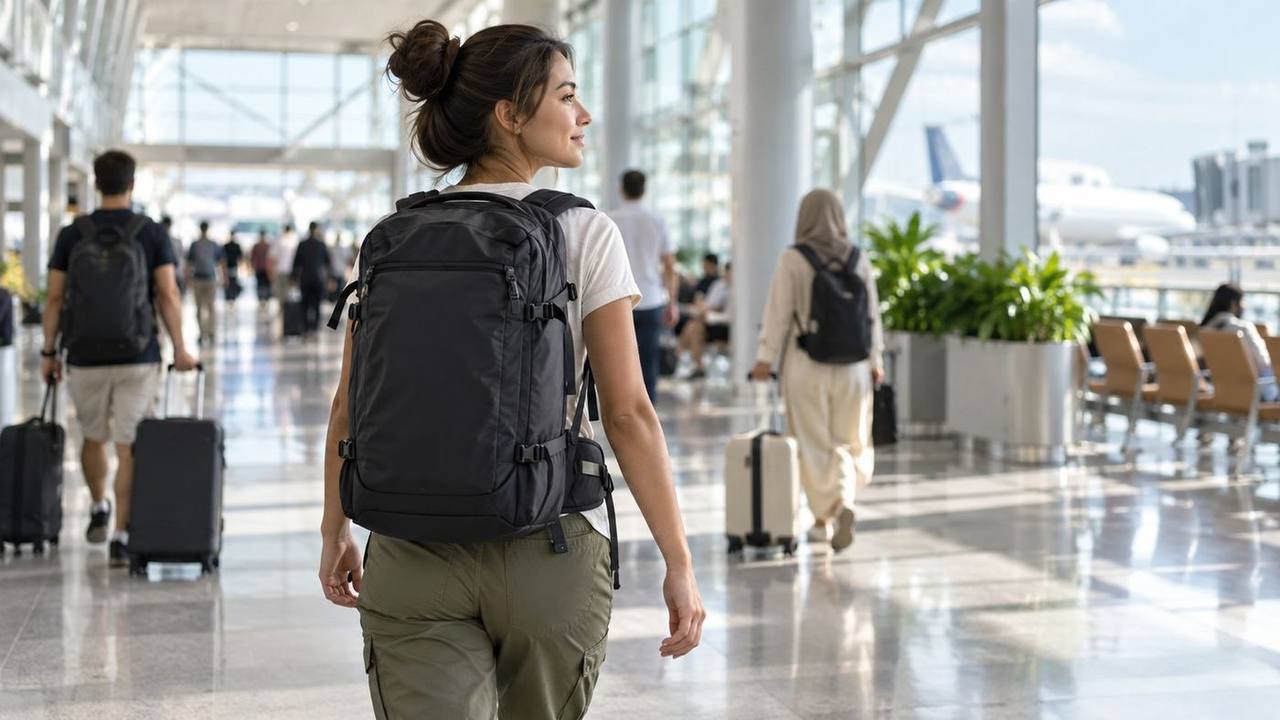
Picture a budget airline check-in counter at KLIA2. Someone lifts an overstuffed backpack onto the scale, it reads well over the limit, and they spend the next ten minutes on the floor pulling out clothes. You do not want to be that person.
It happens more often than you might think. A bag that felt fine at home gains weight with a water bottle, a snack bag and a jacket stuffed in at the last minute. Weighing it before you leave home, and again after you add those extras, saves the stress.
Travelling with one carry-on bag is the cheapest and easiest way to backpack around Malaysia and Southeast Asia. You skip baggage fees, avoid queues and never worry about lost luggage. Here is how to do it.
If you have never tried it, start with a short domestic hop, such as Kuala Lumpur to Penang or Kota Kinabalu. A three or four day trip is a low-risk way to learn what you really use, and the same list works for longer trips.
Know your cabin limit first
Your packing list is shaped by your airline’s rules, so start here. Budget flights are how many travellers hop between cities and islands, and every airline sets its own cabin allowance.
Check your airline’s cabin limit before you pack. Many budget airlines allow around 7kg in the cabin, often shared between one main bag and a small personal item that fits under the seat. Full-service airlines are sometimes more generous, but not always. Size matters too, so look up the maximum measurements for both bags.
On the airline’s baggage page, look for:
- Total weight. Is the limit for each bag, or for both bags together?
- Main bag size. Measure your bag fully packed, including wheels, handles and hip belt pads.
- Personal item size. It usually has to fit under the seat in front of you.
- Paid add-ons. Some budget airlines sell extra cabin allowance or priority boarding, which can cost less than a checked bag.
These rules change, and they can differ between airlines on the same trip. Check again a few days before you fly, and pack for the strictest airline on your route.
The safe target is simple: one small backpack plus a daypack, light enough to lift into the overhead locker with one hand, and within the lowest limit of any airline you will use.

Choosing the bag
A carry-on backpack of around 30–40 litres usually fits the size limit. Before buying, check the exact measurements, including wheels or hip belt pads. Look for:
- Light empty weight. Every 500g the bag weighs is 500g less for your things.
- Clamshell opening, which opens like a suitcase so you can find things easily.
- Compression straps to keep the bag inside the size limit.
- A tuck-away hip belt for long walks between bus stations and hostels.
For your personal item, a packable daypack works well. Once you land, it becomes your sightseeing bag. See Daypack essentials for city sightseeing for what goes in it.
The one-bag packing list
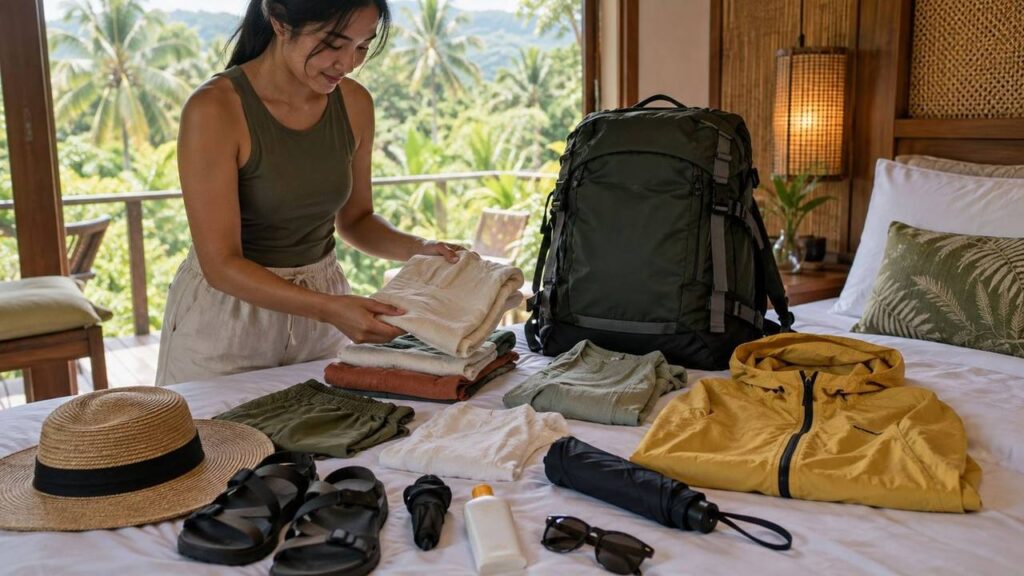
This is for a trip of any length in Malaysia’s hot, humid climate. You wash clothes as you go, so a two-week trip and a two-month trip look almost the same.
Clothes
- 4 T-shirts or tops (quick-dry or merino blend)
- 1 light long-sleeved shirt (sun, mosquitoes and temple visits)
- 1 pair of shorts
- 1 pair of light long trousers or a long skirt
- 1 swimsuit
- 4–5 pairs of underwear
- 2–3 pairs of socks
- 1 light jacket or hoodie for freezing air-conditioned buses
- 1 sarong or large scarf (beach cover, blanket, modest cover-up)
- Sleepwear, or use a T-shirt and shorts
Shoes
- Wear your bulkiest pair on the plane, such as trainers or trail shoes.
- Pack one pair of sandals or flip-flops.
Two pairs is enough. Shoes are the heaviest thing most people pack.
Toiletries
The liquids rule shapes this part. Most airports still ask for liquids, aerosols and gels in your cabin bag to be in small containers, usually 100ml or less, packed together in one clear resealable bag. A few airports have relaxed this with newer scanners, but it is not the same everywhere, so pack as if the rule applies.
To make this easy:
- Use solid shampoo, conditioner and soap bars.
- Buy sunscreen and insect repellent after you land. Guardian and Watsons pharmacies, plus convenience stores, are easy to find in Malaysian towns.
- Bring a small toothpaste, deodorant (stick, not spray) and any medicine.
- Check your airline’s list of restricted cabin items before you pack razors, scissors or nail clippers.
A good first stop after landing is a pharmacy or supermarket at the airport or in the first mall you pass. Pick up sunscreen, insect repellent and a full-size shampoo there, and leave anything half-used behind at your last hostel before you fly out again.
Tech
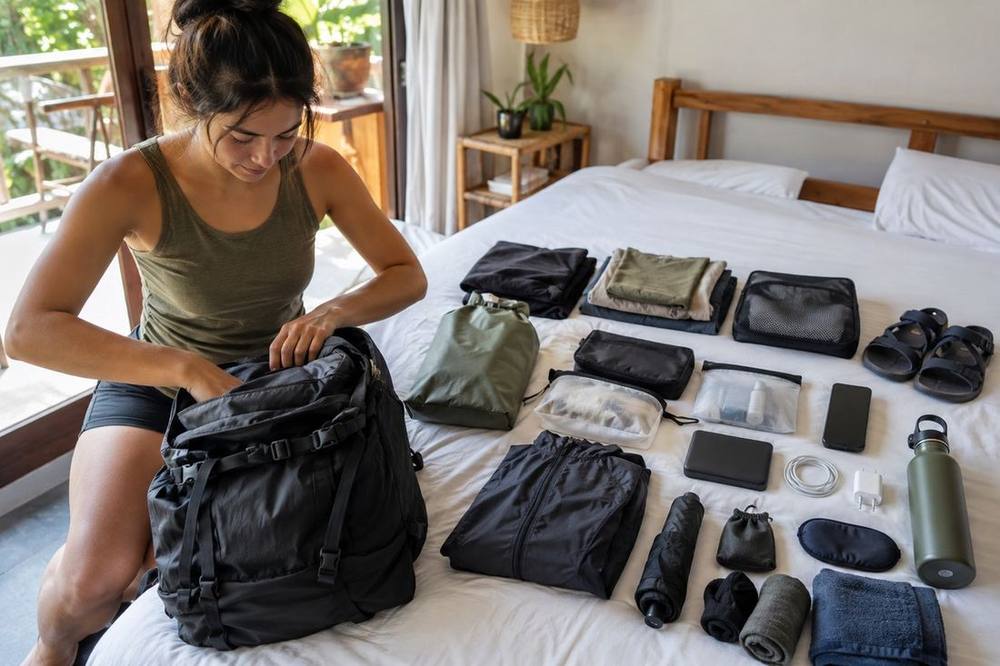
- Phone and cable
- Power bank (10,000mAh is plenty)
- Universal adapter, since Malaysia uses Type G three-pin sockets (230V according to TNB)
- Earbuds
Power banks must stay in your cabin bag, never in checked luggage. Many airlines now also limit how many you can carry and ban using or charging them during the flight. These rules have tightened recently and vary by airline, so check yours before you fly. There is more on this in Travel gadgets worth bringing, and ones to leave behind.
Documents and money
- Passport (and a copy stored separately)
- Bank cards and some cash
- Travel insurance details
- Booking confirmations saved offline
Small extras
- Packable daypack
- Refillable water bottle (empty it before security)
- Small microfibre towel
- Small dry bag for rain and boats
- Padlock for hostel lockers
- Packing cubes
How to stay within your cabin limit
Weight sneaks up on you. These habits help:
- Weigh your bag at home with a luggage scale. Pack, weigh, remove, weigh again.
- Wear your heaviest items on the plane: shoes, jacket and long trousers.
- Use your pockets. Phone, power bank and passport can go in a jacket pocket.
- Choose light fabrics. Thin synthetic tops weigh much less than cotton.
- Do laundry. Most towns have self-service laundromats and many hostels offer a wash service.
- Buy, do not carry. Toiletries, snacks and even cheap clothes are easy to find at night markets and shops.
- Leave “just in case” items. If you only might need it, you can almost always buy it in Malaysia.
A worked example
Say your airline allows 7kg in total and your packed bags weigh 8.2kg. Before you start pulling things out at random, try this order:
- Move your jacket, long trousers and trainers onto your body. That alone can save close to a kilo.
- Put the power bank and phone in your jacket pocket.
- Swap any liquid toiletries for solid bars, or plan to buy them after landing.
- If you are still over, the heaviest single items are usually a second pair of shoes, a book or a cotton hoodie. Leave one behind.
Most travellers find the biggest savings come from shoes and cotton clothes, not from the small items.
Cabin bag check at a glance
| What to check | Why it matters |
|---|---|
| Total cabin weight | Many budget airlines allow around 7kg, and some count both bags together |
| Main bag size | A bag over the size limit may be sent to the hold for a fee |
| Personal item size | It usually has to fit under the seat |
| Liquids | Small containers in one clear bag at most airports |
| Power banks | Cabin bag only, with limits that vary by airline |
| Paid add-ons | Extra cabin allowance can cost less than a checked bag |
What to leave behind
- A third pair of shoes
- Jeans (heavy and slow to dry)
- A full-size towel
- Hair dryer
- Big bottles of shampoo or sunscreen
- More than one book (use an e-reader or your phone)
- Outfits for “maybe” events
What if you are going trekking or diving?
One bag still works for most trips. If you plan jungle treks, pack leech socks and one set of quick-dry trekking clothes, and rent heavier gear locally where you can. For Taman Negara or Borneo, see Jungle Trekking Packing List: What to Bring for Rainforest Hikes. If you are diving, most dive shops provide equipment.
Final check before the airport
The night before you fly:
- Weigh your bag and daypack together.
- Put liquids in a clear one-litre bag at the top.
- Put your power bank in your cabin bag, not in a pocket you will check.
- Check your airline’s latest cabin limits on its website.
Travel light once and you will rarely go back. You will be the one walking straight past the check-in queue at KLIA2.
Sources
- Tenaga Nasional Berhad, Electricity Supply Application Handbook 3.1: https://www.tnb.com.my/assets/files/2022_ESAH_3.1.pdf (checked Oct 2026)
- AirAsia, “Malaysia Plug Type & Voltage Guide” (Sep 2026): https://www.airasia.com/blog/malaysia/malaysia-travel-plug-adapter-guide/