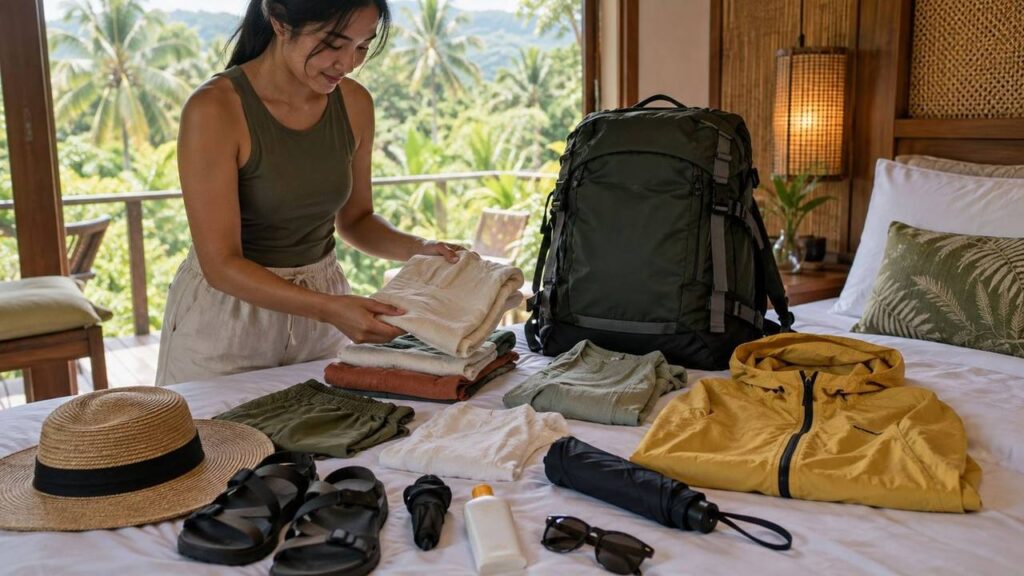
The night before a trip, the bed often looks like a shop exploded on it. Clothes, cables, toiletries, snacks. Then you look at your backpack and wonder how it will all fit.
Packing a backpack is less about squeezing and more about choosing. These hacks work for almost any trip, and they are adjusted for travel in Malaysia, where it is hot, humid and often wet.
Start with the right bag size
A bigger bag does not make packing easier. It just lets you carry more things you do not need. For most trips around Malaysia, a mid-sized backpack is enough, because laundry is cheap and easy to find. Most towns have a dobi (laundry shop) or a self-service laundromat.
If you plan to fly with a budget airline, check the cabin bag size and weight rules before you buy or pack. Fitting everything into cabin baggage saves money and time at the airport.
As a rough guide, a bag of around 35–45 litres suits most one to three week trips if you do laundry once a week. Many first-time backpackers buy a 60 litre or bigger pack “just in case”, then fill it and struggle on every flight of stairs. Try it on with some weight inside before you buy. AirAsia allows two cabin items with a combined weight of 7kg, and Malaysia Airlines economy also allows 7kg in total for your cabin bag and personal item (both checked Oct 2026).
Hack 1: Roll, do not fold
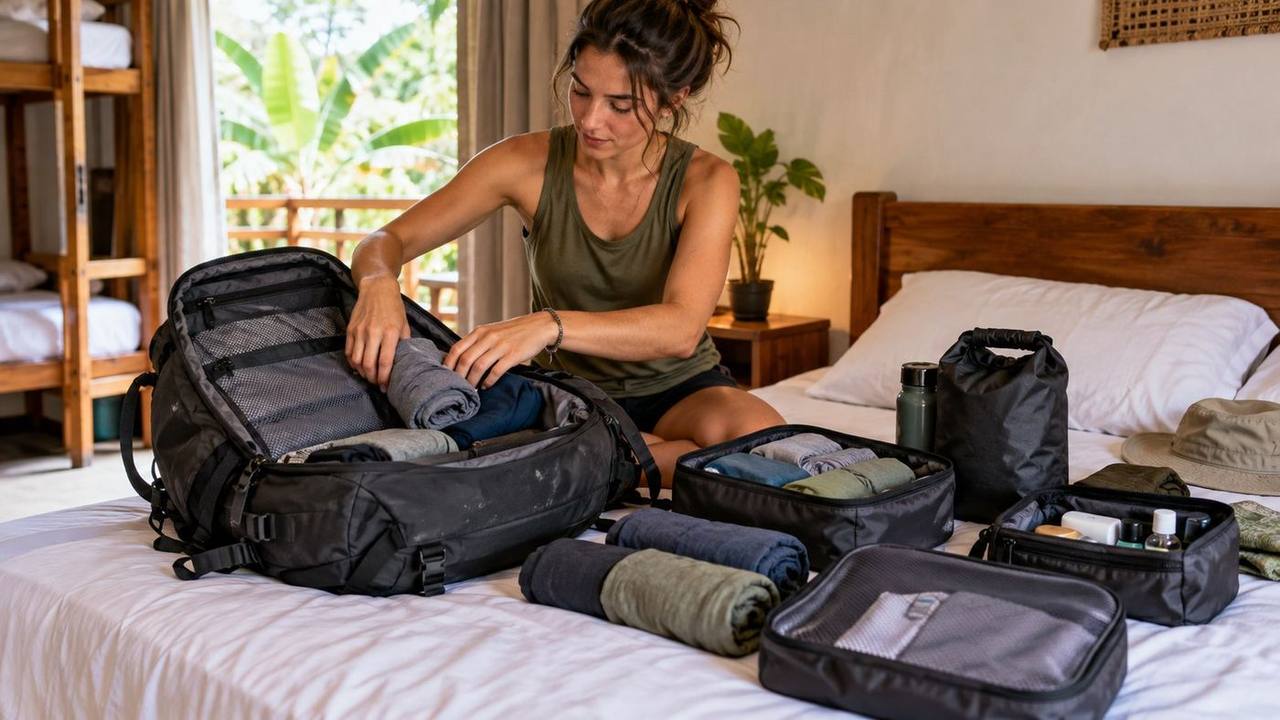
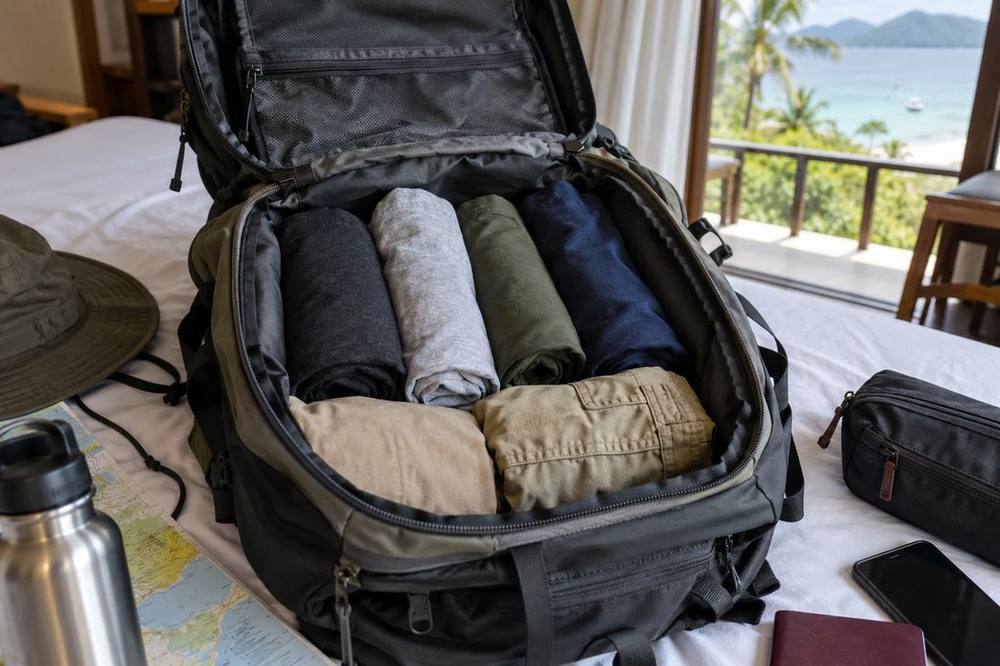
Rolling clothes is the oldest packing trick, and it still works. Rolled T-shirts and shorts take up less space, and you can see everything at a glance when you open the bag.
A few tips:
- Roll tightly from the bottom up.
- Put rolled clothes side by side in a row, like sushi.
- Fold bulkier items, like a light jacket, flat against the back panel.
Packing cubes are a nice extra. One cube for tops, one for bottoms, one for underwear and socks. When you arrive at a homestay, you pull out one cube instead of emptying the whole bag.
Hack 2: Use every empty gap
Empty space inside your bag is wasted space. Look for the gaps.
- Inside your shoes. Stuff socks, a phone charger or small toiletries inside.
- Inside a cooking pot or mug, if you carry one for camping.
- Around the edges. Thin items like a sarong or a microfibre towel slide down the sides.
Socks also make good padding. Wrap a small breakable item, like a sunscreen bottle or a gift, in a pair of socks before packing it.
Hack 3: Pack heavy things close to your back
This is less a hack and more a comfort rule. Put the heaviest items in the middle of the bag, close to your spine. Light, soft things go at the bottom and the top.
When the weight sits close to your back, the bag feels lighter and does not pull you backwards. You will notice the difference when walking from a bus station to your guesthouse in the afternoon heat.
Hack 4: Leave some space on purpose
This sounds strange after “use every gap”, but it matters. Always leave a little room when you set off.
You will pick things up on the way. A bag of Sabah tea, a batik sarong, snacks for a long bus ride, a bottle of water. If your bag is full on day one, you will be stuffing things into plastic bags by day five.
A good target is a bag that is about 80% full when you leave home. Anything you buy on the road fills the rest.
Food is the usual culprit. Many travellers end up carrying home packs of white coffee from Ipoh, kuih kapit tins or a jar of sambal. Tins and jars are bulky and heavy, so if you know you will buy them, pack a foldable tote bag that can become a second carry bag on the way home. Wrap jars in clothes and seal them in a zip-lock bag in case they leak.
Hack 5: Leave valuables at home
Gold jewellery, expensive watches and anything with high sentimental value should stay home. Backpacking means hostels, shared rooms, ferries and long bus rides. Things get lost, dropped or left behind.
What you do need to carry, like your passport, bank cards and phone, should be split up:
- Keep your passport and main card in a hidden pouch or an inside pocket.
- Keep a backup card in a different part of your bag.
- Save photos of your passport and bookings on your phone and in your email.
Hack 6: Be realistic about what you will wear
Most of us pack for the trip we imagine, not the trip we take. In Malaysia’s heat, you will live in the same few light, breathable outfits.
Ask yourself these questions for each item:
- Did you wear this on your last trip?
- Does it dry overnight in a humid room?
- Can you wear it with at least two other things you are packing?
If the answer is no, leave it out. Heavy jeans, extra dresses for “maybe” and a third pair of shoes are usually the first to go.
Hack 7: Buy some things when you arrive
You do not need to carry a month of shampoo. Malaysia has 7-Eleven stores, pharmacies like Watsons and Guardian, and small kedai runcit almost everywhere. Basic toiletries, sunscreen, flip-flops, umbrellas and snacks are easy to find in towns.
Here is a simple way to decide what to bring and what to buy:
| Item | Bring from home | Buy in Malaysia |
|---|---|---|
| Prescription medicine | Yes, enough for the whole trip | Not always the same brand |
| Shampoo and soap | Small travel size only | Yes, easy in any town |
| Sunscreen | One small bottle | Yes, but can be pricier in tourist spots |
| Umbrella or poncho | Optional | Yes, cheap in markets and convenience stores |
| Flip-flops | Optional | Yes, everywhere |
| Good walking shoes | Yes | Harder to find in your exact size |
| Power bank and adaptor | Yes | Yes, in malls and phone shops |
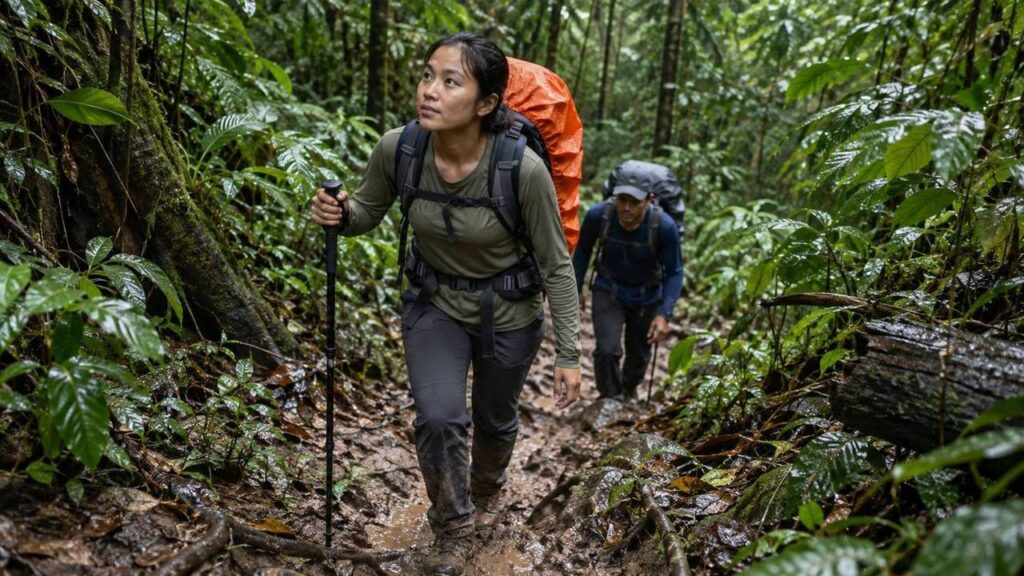
The exception is islands and rural areas. If you are heading to the Perhentians or deep into Taman Negara, buy what you need in the last big town before you go.
Hack 8: Keep a rain plan inside your bag
In Malaysia, rain can come quickly, especially in the afternoon. A good packing system expects it.
- Line the inside of your backpack with a large bin bag or use a rain cover.
- Keep electronics in a zip-lock or dry bag.
- Pack a separate bag for wet clothes or swimwear.
This takes almost no extra space and saves you from a very sad evening of drying everything with a hostel hairdryer.
Hack 9: Pack power banks in your cabin bag
Rules for power banks on flights have changed. The Civil Aviation Authority of Malaysia (CAAM) says power banks are not allowed in checked luggage and must be carried in carry-on baggage, and it advises airlines to keep them out of overhead lockers. Malaysia Airlines allows a maximum of two power banks per passenger, and they cannot be used or charged during the flight. AirAsia also says a maximum of two power banks, each up to 100Wh (AirAsia newsroom, April 2026).
So keep your power bank in your daypack, not in the big bag you check in. Rules differ between airlines, so check yours before flying.
A simple packing order, step by step
- Lay everything out on the bed.
- Remove one third of it. Really.
- Line the bag with a bin bag or dry bag.
- Put soft, light things at the bottom.
- Pack heavy items in the middle, close to your back.
- Fill the gaps with socks, chargers and small items.
- Put rain gear, toiletries and snacks at the top.
- Keep passport, phone, power bank and wallet in your daypack.
Common packing mistakes to avoid
- Packing the night before. Rushed packing means forgotten chargers and too many clothes. Pack a day early.
- Burying the things you need first. If your rain cover, passport or water bottle is at the bottom, you will unpack everything at the bus station. Keep them at the top or in an outside pocket.
- Never testing the full bag. Walk around the block with it on. If it hurts after ten minutes, it will hurt much more after an hour in the heat.
For a full list of small items worth carrying, see Backpacker Essentials: 8 Small Things Worth Packing. If you are going hiking, also read What Not to Pack for a Trekking Trip.
Next time you pack, try just two of these hacks: roll your clothes and leave 20% of the bag empty. You will feel the difference on the first walk from the bus station.
Sources
- Civil Aviation Authority of Malaysia, Safety Information 03/2025, “Safety Measures for the Carriage of Lithium-Ion Battery Power Bank”: https://www.caam.gov.my/wp-content/uploads/2025/03/SI-03_2025-Safety-Measures-for-the-Carriage-of-Lithium-Ion-Battery-Power-Bank.pdf
- Malaysia Airlines, “Additional Restrictions” (power banks): https://www.malaysiaairlines.com/my/en/travel-info/baggage/additional-restrictions.html
- AirAsia Newsroom, “AirAsia Travel Advisory: Cabin Baggage Allowance Update”: https://newsroom.airasia.com/news/2020/7/6/airasia-travel-advisory-cabin-baggage-allowance-update (checked Oct 2026)
- Malaysia Airlines, “Carry-On & Cabin Baggage Rules”: https://www.malaysiaairlines.com/us/en/travel-info/baggage/cabin-baggage.html (checked Oct 2026)
- AirAsia Newsroom, “AirAsia Philippines Updates Guidelines on Portable Electronic Devices and Power Banks” (30 Apr 2026): https://newsroom.airasia.com/stories/2026/4/30/airasia-philippines-updates-guidelines-on-portable-electronic-devices-and-power-banks (checked Oct 2026)